
AI May Be Making Integrated Marketing More Important, Not Less
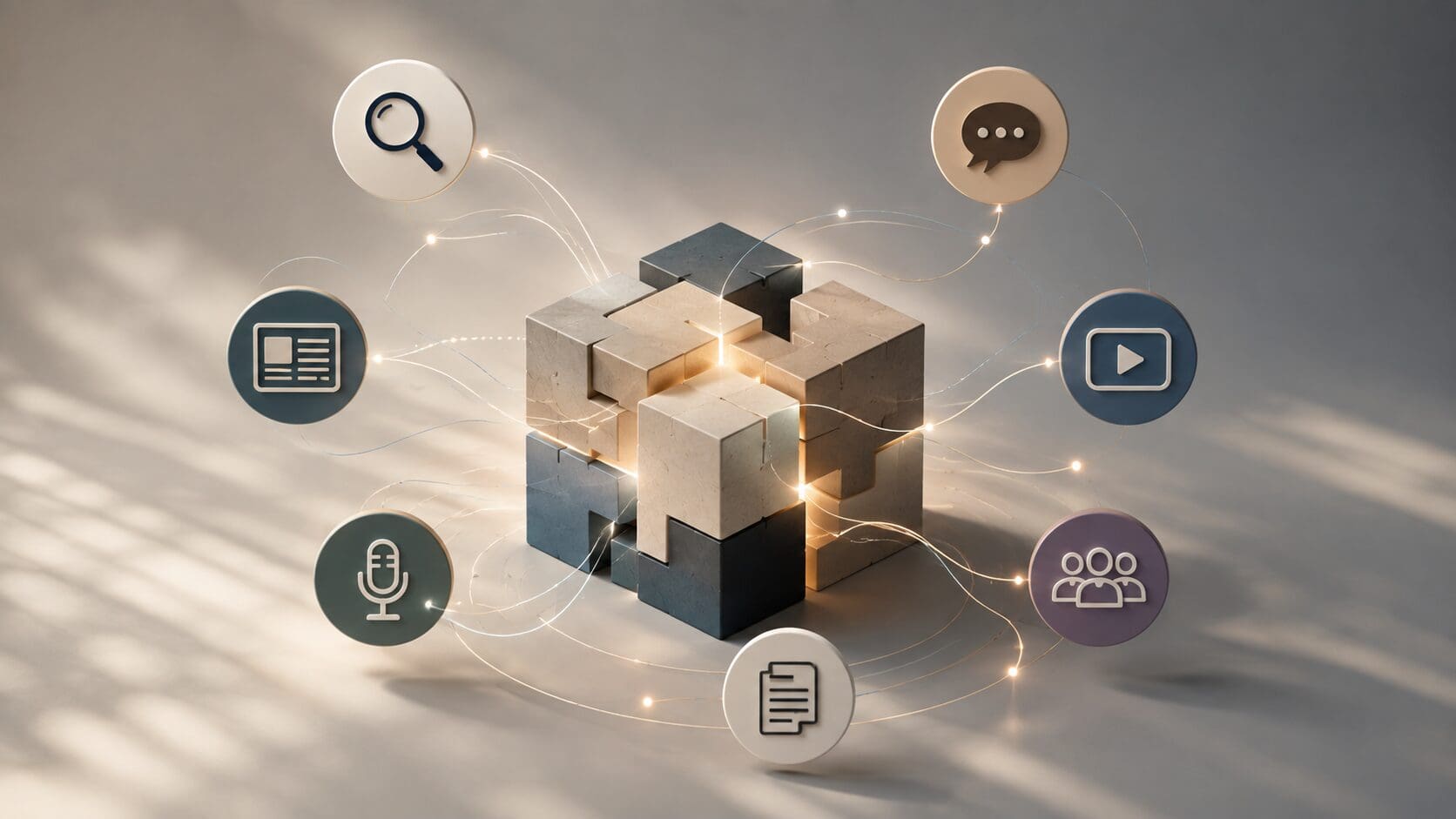
For the past decade, marketing has become increasingly precise.
We can reach someone based on what they search, what they watch, what they click and where they are in the buying journey. We can retarget them, measure them, optimize campaigns in real time and attribute conversions back to specific tactics.
That precision has made marketing smarter and more accountable.
But it may also have encouraged us to think about marketing in pieces.
Search has its job. Social has its job. PR has its job. Television has its job. Content has its job. Each has its own strategy, budget, metrics and dashboard.
Then AI arrived.
And somewhat unexpectedly, one of the newest technologies in marketing may be reminding us why all of those pieces need to work together.
AI Is Changing How Discovery Happens
For years, digital discovery followed a relatively familiar path.
A consumer had a question, opened a search engine, reviewed the results and clicked through to the sources that seemed most relevant.
AI-powered search changes that experience.
Consumers can now ask complex questions and receive synthesized answers drawn from information across the web. Research, comparison and evaluation can begin before someone ever reaches a company’s website.
We’re already seeing evidence that this changes behavior.
Pew Research Center found that Google users clicked a traditional search result on 15% of visits without an AI summary, compared with just 8% when an AI summary appeared.
McKinsey’s research found that roughly half of consumers use AI-powered search, with 44% of those users identifying it as their primary and preferred source of insight.
Search isn’t disappearing.
But the way people discover and evaluate brands is expanding.
And that’s where the implications for marketers become much bigger than search.
So, What Exactly Is GEO?
If SEO is about helping content get found and ranked by search engines, GEO—generative engine optimization—is about helping a brand and its expertise be understood and surfaced by AI-powered platforms.
The distinction matters.
Traditional search largely points people toward sources. Generative search can draw from multiple sources, synthesize the information and provide an answer directly.
That means visibility is no longer determined only by how well a page on your website ranks.
AI platforms may encounter your organization through your website, but also through news coverage, industry publications, videos, reviews, social platforms, interviews, research and other credible sources across the web.
GEO is the emerging practice of making sure the information surrounding a brand is clear, credible, well-supported and structured in ways AI systems can understand and potentially use.
But here’s where the conversation gets more interesting.
If AI-powered discovery is drawing signals from across the information ecosystem, GEO can’t simply become another digital tactic sitting next to SEO.
It depends, at least in part, on the authority and visibility marketing is building everywhere else.
Your Brand Exists in an Ecosystem
A company’s website tells an important part of its story.
But it isn’t the entire story.
Customers share experiences in reviews. Executives offer perspectives on LinkedIn. Subject-matter experts appear in videos and podcasts. Journalists and industry publications provide independent coverage. Research gets cited. Conversations happen across social platforms.
Together, those sources create a much larger information ecosystem around the brand.
And emerging research suggests that ecosystem matters.
In a 2025 analysis of 75,000 brands, Ahrefs found that branded web mentions showed a stronger correlation with AI visibility than many traditional SEO metrics. YouTube mentions demonstrated the strongest correlation in the study, while the number of pages published on a brand’s own website showed a considerably weaker relationship.
Ahrefs cautions that correlation doesn’t prove causation. But the findings raise an important question: could building visibility and authority across the web matter as much as simply producing more content on your own channels?
McKinsey’s research adds another dimension. Its analysis found that a brand’s own website may represent only 5–10% of the sources referenced by AI search.
Muck Rack’s 2026 analysis of more than 25 million links cited across ChatGPT, Claude and Gemini found that 84% came from earned media, with journalism accounting for 27%. Meltwater’s analysis of 9.5 million AI citations across six major models found LinkedIn was the second-most-cited source in its B2B research.
None of these findings provides a formula for earning visibility in AI-generated answers.
But together, they point toward something more fundamental:
What exists around a brand matters.
And that may make the case for integrated marketing stronger than it has been in years.
How This Plays Out in the Real World
Imagine a healthcare organization identifies a growing workforce shortage and publishes original research about what’s happening and why.
That’s a good piece of content.
But if the strategy stops with publishing it on the website and optimizing it for search, much of its potential value is left on the table.
Instead, the research becomes the beginning of a larger story.
A local television station interviews the CEO about the findings. An industry publication references the research in an article. One of the organization’s experts joins a podcast to talk about what employers are seeing. The CEO shares a perspective on LinkedIn. Short videos turn the most interesting findings into content people can easily understand and share.
Paid and traditional media introduce the issue—and the organization’s point of view—to people who weren’t searching for it in the first place.
Now something different is happening.
Someone sees the organization on television. Later, they encounter a video. A colleague shares the article. Eventually, they search the topic, visit the organization’s website or ask an AI platform a related question.
They may never know that all of those encounters were connected.
But the brand is becoming more familiar, more credible and more authoritative with each one.
At the same time, that activity is creating a broader body of credible information for search engines and AI platforms to discover and understand.
One piece of research didn’t simply become ten pieces of content.
It became the foundation of a connected marketing ecosystem.
That’s what integrated marketing can do that an isolated tactic can’t.
The Future of Marketing Looks Surprisingly Familiar
For all the conversation about AI, algorithms, GEO and the future of search, we may be arriving at a surprisingly familiar conclusion.
Brands have to earn a position in the market before they can expect to capture demand from it.
That has always been one of the fundamental jobs of marketing.
Awareness makes the brand known.
Relevance makes it meaningful.
Authority makes it credible.
Consistency makes it memorable.
Together, they create preference and demand.
Digital marketing gave us extraordinary tools for capturing that demand.
Someone searches. We buy the keyword.
Someone visits. We retarget them.
Someone engages. We move them toward conversion.
Those capabilities aren’t going away. But they were never meant to carry the entire burden of marketing.
Because someone has to create the demand first.
A search ad can put a brand in front of someone already looking for a solution. But it doesn’t explain what created the interest that led to the search.
Why is one brand familiar while another isn’t? What makes one company immediately feel more credible? Why might someone search for a brand by name instead of simply searching the category? And when several options appear, what makes one already feel like the obvious choice?
Those aren’t search questions. They’re marketing questions.
And they’re answered by the cumulative effect of what people see, hear, experience, learn and come to believe about a brand over time.
That is also why AI-powered discovery is so interesting.
The same connected marketing ecosystem that builds awareness, relevance, authority and preference with people is creating a broader body of information around the brand—information that search engines and AI platforms can increasingly discover, interpret and use.
Think about the ecosystem:
Paid media creates awareness.
Traditional media delivers reach and legitimacy.
PR and earned media provide third-party authority.
Social creates conversation and demonstrates expertise.
YouTube and video make expertise visible.
Website content and SEO establish owned authority and depth.
Thought leadership contributes original knowledge and perspective.
Search captures intent.
GEO helps make those signals understandable and discoverable in AI-powered environments.
No single channel has to do everything.
But everything has to work together.
The goal isn’t to be everywhere. It’s to give each part of marketing a clear job while ensuring those jobs collectively build the same thing: a clear, relevant, credible and recognizable position in the market.
Maybe that’s what’s most interesting about this moment.
One of the newest technologies in marketing isn’t making the fundamentals obsolete.
It’s making the value of those fundamentals easier to see.
The future may not belong to the brands that optimize the best individual tactic.
It may belong to the brands that connect them.