
Before the Campaign: Where Marketing Success Begins

Most marketing campaigns don’t fail because of poor creative, ineffective advertising, or the wrong marketing channel. By the time organizations launch a campaign, they have already made many of the decisions that determine its success.
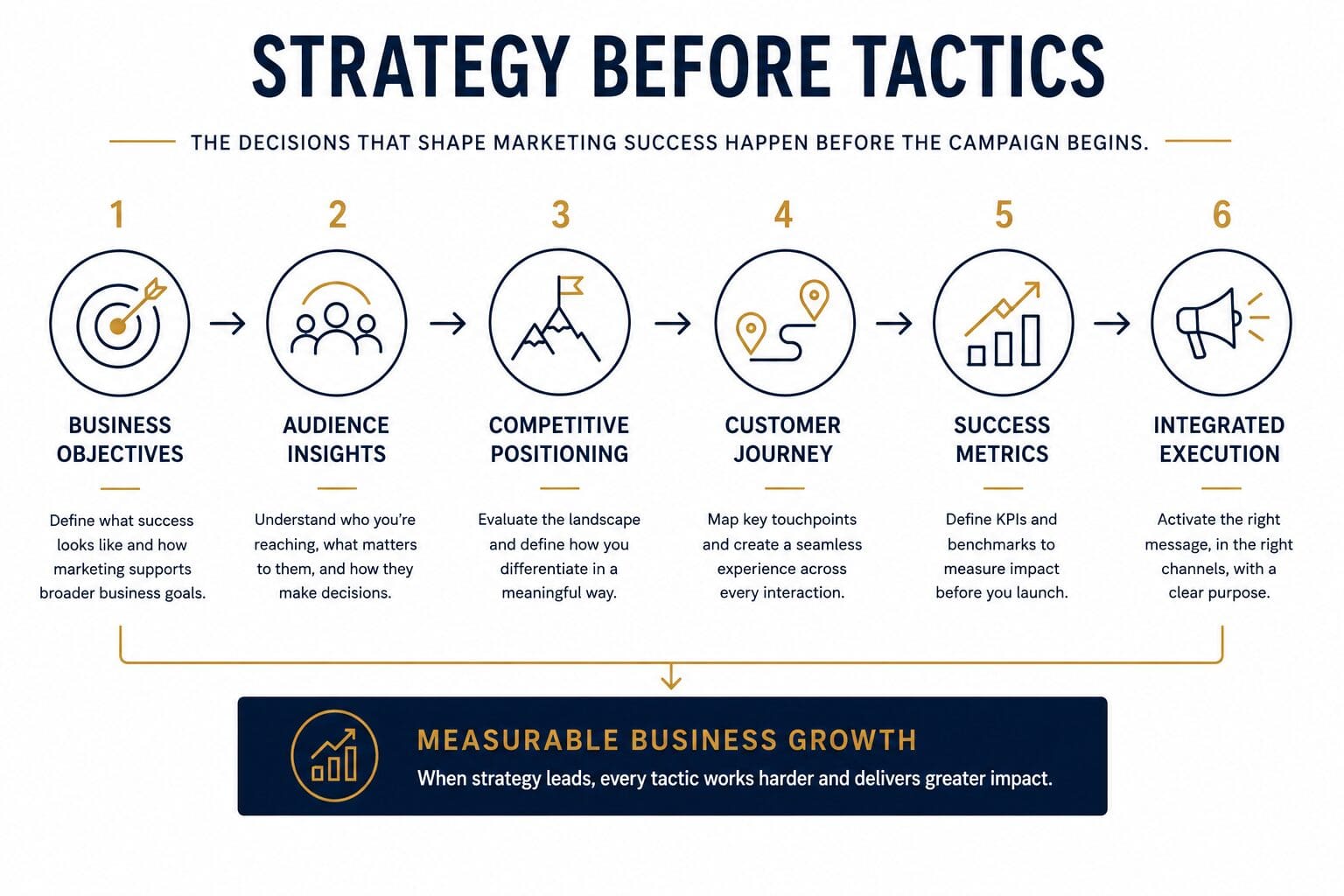
Successful marketing begins long before execution. It begins with understanding the audience, evaluating the competitive landscape, and aligning marketing with business objectives. Before a single tactic is executed, organizations must also define what sucess looks like. These strategic decisions shape every creative concept, channel selection, and customer interaction that follows.
While the campaign may be most visible part of marketing, the strategy developed before launch determines whether those efforts achieve meaningful business results.
Why Strategy Comes Before Marketing Tactics
Strategy is often misunderstood as a marketing plan, a creative campaign, or collection of tactics. In reality, strategy is the decision-making framework that guides every marketing effort before execution begins. It defines four essential elements: what the organization wants to accomplish, who it needs to reach, how marketing supports business objectives, and how leaders will measure success.
Strategic management has long recognized this distinction. In What Is Strategy?, Harvard Business School professor Michael Porter argues that strategy is fundamentally different from operational effectiveness. Operational effectiveness focuses on performing activities well. Strategy focuses on making deliberate choices that create a unique position in the marketplace. That same principle applies to marketing. Strategy defines the direction before tactics determine execution.
Every effective marketing strategy begins by answering a series of fundamental business questions. Who are we trying to reach? What problem are we solving for our audience? How does this campaign support our broader organizational goals? What differentiates us from the competition? How will success be measured? The answers to these questions shape every decision that follows. They influence messaging, creative development, channel selection, and campaign measurement.
Organizations often make these decisions based on assumptions rather than evidence. Internal perspectives, anecdotal feedback, and years of experience provide valuable context. However, they don’t always reflect how customers actually think, evaluate their options, or make purchasing decisions. Strategic planning reduces that uncertainty by validating assumptions through research and using reliable insights to guide decision making.
Consider a healthcare organization preparing to launch a marketing campaign. Internal stakeholders may assume that physician credentials are the primary reason patients choose a provider. Research may reveal that appointment availability, insurance acceptance, online scheduling, or convenient locations have a greater influence on patient decisions. Those findings don’t simply change the messaging, they influence the campaign’s objectives, creative direction, channel strategy, and overall customer experience.
This same principle applies across every industry. Strategy is the process of making informed decisions before execution begins. Organizations create a stronger foundation when they establish clear objectives, understand their audience, validate assumptions, and align marketing with business priorities before launching a campaign. They create a foundation that allows every tactic to work together towards a common goal.
Align Marketing with Business Goals
Every marketing initiative should begin with a clear understanding of the business outcome it is intended to achieve. Before organizations develop creative concepts, select marketing channels, or allocate budgets, organizations must determine how marketing will support their broader strategic objectives.
McKinsey & Company has similarly emphasized that marketing creates the greatest value when it is directly connected to business strategy rather than operating as an independent function. When organizations align marketing decisions with strategic priorities, they become investments in long-term growth rather than isolated promotional activities.
Business goals provide the direction that shapes every marketing decision. They help organizations prioritize audiences, refine messaging, allocate resources, select the right channels, and establish meaningful measures of success. Without that alignment, marketing efforts can quickly become driven by individual tactics rather than a coordinated strategy. This results in disconnected initiatives that consume time and budget without advancing organizational priorities.
Consider two organizations launching digital advertising campaigns. At first glance, the campaigns may appear similar. They both include paid search, social media, advertising, and landing pages. However, their strategies may be entirely different. One organization may be focused on generating qualified leads, while another is working to expand into a new market, strengthen brand awareness, or retain existing customers. Although the tactics look similar, each organization makes fundamentally different strategic decisions because each campaign supports a different business outcome.
When organizations align marketing strategy with business objectives from the beginning, every campaign becomes part of a larger organizational strategy rather than a standalone initiative. That alignment creates greater consistency across marketing efforts, improves decision-making, helps organizations invest resources more effectively, and provides a clearer framework for evaluating success. Once organizations understand what they are trying to accomplish, the next strategic decision is determining how they will differentiate within an increasingly competitive marketplace.
Understand the Competitive Landscape
Every marketing campaign competes for something far more valuable than impressions or clicks, it competes for attention, trust, and ultimately a customer’s decision. Before organizations can determine how to position themselves, they need to understand the environment in which they are competing.
Competitive analysis is not about copying another organization’s messaging or creative. It is about identifying opportunities to differentiate. Understanding how competitors position themselves, the audience they serve, the promises they make, and where gaps exist in the market allows organizations to build strategies that highlight their own unique strengths rather than blending into the competitive landscape.
Effective positioning also requires looking beyond competitors themselves. Organizations should evaluate broader market trends, evolving customer expectations, emerging technologies, and changes in buyer behavior that could influence future demand. These insights help leaders make proactive decisions instead of reacting to market changes after they occur.
When organizations understand both their competitors and the broader market, they can develop marketing strategies that create meaningful differentiation rather than simply increasing marketing activity.
Build an Integrated Customer Journey
Customers rarely experience organizations through a single marketing channel. They move between search engines, websites, social media, digital advertising, email, referrals, online reviews, and in-person interactions before making a decision. From the customer’s perspective, these are not separate marketing efforts, they are all part of one experience.
Without a unified strategy, each touchpoint risks operating independently. Messaging changes from one campaign to the next, departments pursue different priorities, and customer experiences become inconsistent. While each initiative may perform well individually, the overall experience can feel disconnected and confusing.
Strategic planning ensures that every interaction supports the same business objectives and reinforces a consistent brand experience. Marketing, sales, customer service, and leadership should all be working toward the same organizational goals, creating a seamless journey from initial awareness through long-term customer relationships.
An integrated customer journey is not simply about consistency in messaging. It is about designing an experience that builds trust at every stage of the decision-making process.
Define Success Before the Campaign Begins
One of the most common mistakes organizations make is defining success after a campaign has already launched. By that point, it becomes easy to focus on whichever metrics appear most favorable instead of evaluating whether the campaign achieved its intended business objectives.
Effective strategic planning establishes success before execution begins. That means identifying the outcomes the organization wants to achieve, selecting performance indicators that align with those objectives, and creating benchmarks that provide meaningful context throughout the campaign.
Not every campaign should be measured the same way. Organizations should evaluate a lead generation campaign differently than a campaign focused on brand awareness or customer retention. The metrics should reflect the business objective, not simply the marketing activity.
When organizations define success before launching a campaign, reporting becomes more meaningful, optimization becomes more intentional, and leaders can evaluate marketing performance based on business impact rather than isolated marketing metrics.
Strategy Creates Consistency, Not Just Campaigns
Many organizations don’t struggle because they lack marketing resources. They have talented teams, experienced partners, compelling creative, and access to more marketing channels than ever before. The challenge is that organizations often deploy those resources without a long-term strategic framework.
As a result, marketing becomes reactive. Campaigns launch, messaging changes, budgets shift between initiatives, and priorities evolve from month to month. Individual tactics may produce short-term results, but without an overarching strategy, each campaign operates as a separate initiative rather than contributing to sustained organizational growth.
The organizations that achieve the greatest success are not necessarily those producing the most content or launching the most campaigns. They are the ones making disciplined strategic decisions that ensure every marketing investment moves the organization closer to its long-term goals.
Before the Campaign Comes Strategy
Campaigns are often the most visible part of marketing, but they represent only a small portion of what drives meaningful results. Long before organizations develop creative, launch advertisements, or publish content, organizations are making decisions that determine whether those efforts will succeed.
Strategy is the framework that connects business objectives, audience insights, competitive positioning, customer experience, and performance measurement into a unified marketing approach. Without it, even well-executed campaigns can become disconnected efforts that consume time, budget, and resources without advancing broader organizational goals.
The organizations that consistently outperform their competitors are not simply executing better campaigns. They are making better decisions before execution ever begins. When strategy leads and tactics follow, marketing becomes more focused, more measurable, and more capable of driving long-term business growth.