
From Data to Decisions: How Marketing Analytics Drive Measurable Results

Modern audiences move across platforms, devices, and content experiences faster than ever before. That behavior generates enormous amounts of marketing data but without strategic interpretation, data alone rarely improves performance. Many organizations struggle to answer one critical question: What is the data actually telling us, and how should it influence the next business decision?
Successful brands are no longer relying on assumptions alone. They are using marketing analytics to uncover audience behavior, optimize campaign performance, improve return on investment, and turn data into measurable marketing results.
Why Marketing Analytics Matter More Than Ever
Modern marketing generates an endless stream of data. Clicks, views, website traffic, and conversations all provide valuable insight into how audiences behave and how campaigns perform. However, raw numbers without context are just noise.
What separates growing brands from stagnant ones is their ability to take that noise and turn it into strategic action. Marketing analytics and key performance indicators (KPIs) help businesses identify what is working, where opportunities exist, and how marketing efforts contribute to larger business goals.
When interpreted effectively, these insights allow organizations to make informed decisions, optimize campaign performance, allocate budgets more efficiently, and move beyond guesswork toward measurable growth.
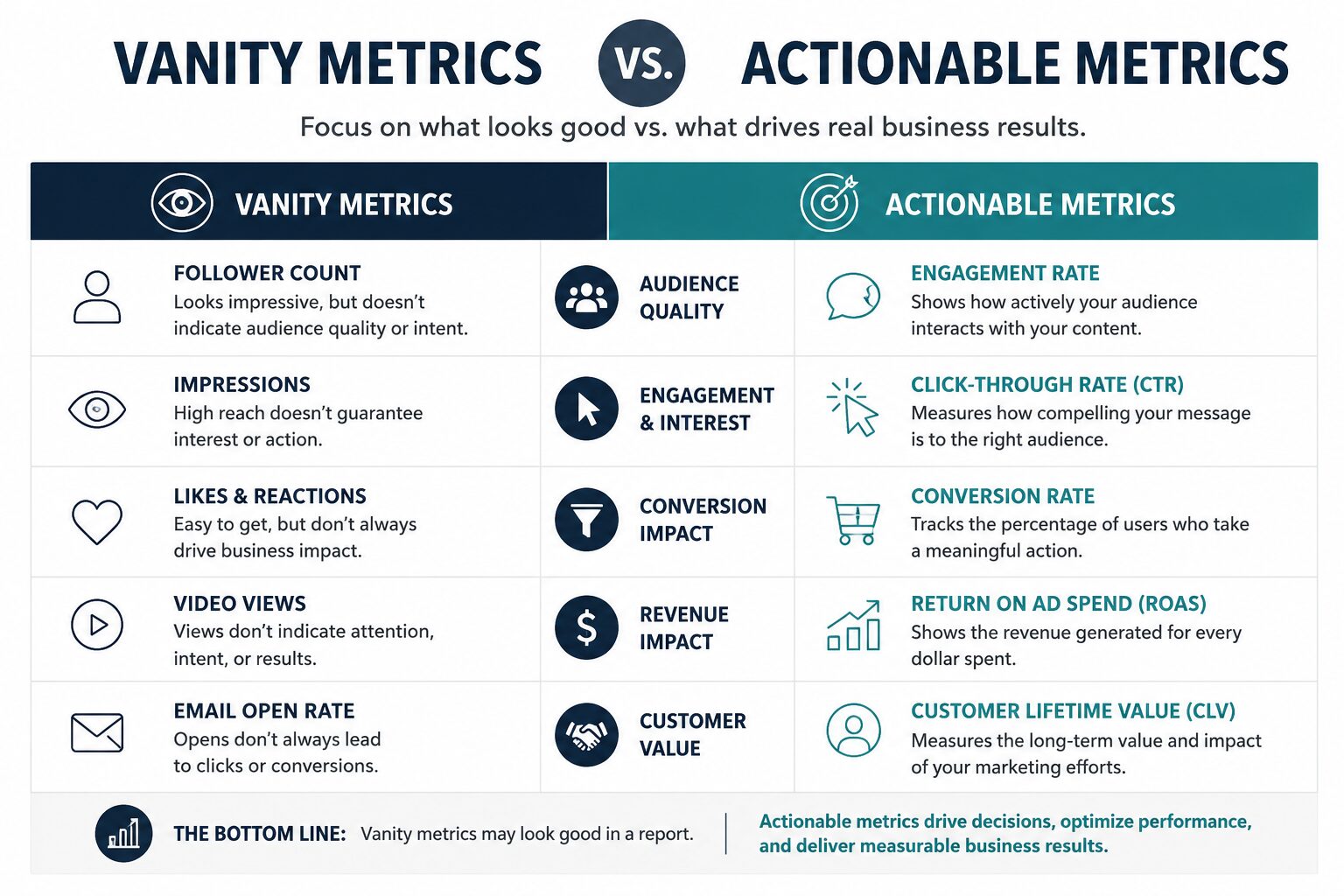
Understanding the Difference: Vanity Metrics vs Actionable Metrics
Not all metrics provide the same strategic value. The difference between visibility metrics and performance metrics often determines whether campaigns simply generate attention or drive measurable business outcomes.
Vanity metrics such as page views, follower counts, and total impressions can help measure visibility and reach, but on their own, they rarely indicate whether a campaign is driving meaningful engagement, conversions, or measurable business impact.
Actionable metrics, on the other hand, provide deeper insight into performance and help businesses make informed decisions. Metrics like click-through rate (CTR), conversion rates, cost per click (CPC), and engagement rates reveal how audiences interact with campaigns and if marketing efforts are producing measurable results.
The difference between vanity metrics and actionable insights ultimately comes down to context. High impression rates may appear successful at first glance, but if those impressions are not leading to engagement, qualified leads, or conversions, the long-term business impact may be limited.
While awareness metrics still play an important role in measuring visibility, the most effective marketing strategies prioritize performance indicators that reveal audience intent, engagement quality, and long-term business impact.
Key Marketing Metrics That Drive Smarter Decisions
From engagement and conversion rates to customer acquisition costs and return on ad spend, the right metrics provide businesses with the insight needed to evaluate performance and guide future strategy.
Website Traffic Analytics
Website traffic measures how audiences are discovering and interacting with your brand online, but traffic volume alone provides limited strategic value. Deeper analysis of traffic sources, bounce rates, engagement behaviors, and time on the page offers more meaningful insight into audience quality and campaign effectiveness.
Are paid search visitors converting at a higher rate than social media audiences? Is organic search attracting more qualified leads?
Conversion Rates
Conversion rates measure the percentage of visitors who complete a desired action, whether that is submitting a form, downloading a resource, or making a purchase. More importantly, this metric provides insight into how effectively your messaging, design, and user experience align with audience intent and expectations.
Low conversion rates usually indicate friction within the customer journey. Strong conversion performance signals that your marketing strategy is successfully resonating with the correct audience and guiding them toward meaningful action.
Cost Per Lead (CPL) and Customer Acquisition Cost (CAC)
CPL measures how much investment is required to generate a single lead, while CAC provides a broader view of the total cost associated with converting a prospect into a paying customer. Together, these metrics provide critical insight into marketing efficiency, campaign performance, and long-term growth sustainability.
Rising CPL alongside declining lead quality may indicate the need to refine audience targeting, messaging, or creative strategy. Similarly, when CAC begins to outpace customer lifetime value, it signals inefficiencies in the overall growth strategy.
Return on Ad Spend (ROAS)
ROAS measures the amount of revenue generated for every dollar invested in advertising, making it one of the clearest indicators of campaign profitability and marketing efficiency. A ROAS of 3:1, for example, means a campaign is generating $3 in revenue for every $1 spent.
More importantly, this metric provides valuable insight into which campaigns, platforms, and audiences deliver the strongest financial return.
Click-Through Rate (CTR)
Click-through rate (CTR) measures the percentage of viewers who engage with an ad, email, or content after seeing it. As an engagement metric, CTR provides valuable insight into how effectively messaging and creative assets capture attention and generate interest.
Strong CTR often signals alignment between audience intent, campaign messaging, and creative execution, while lower engagement rates may reveal opportunities to refine targeting, positioning, or content strategy.
Engagement Rates and Social Media Engagement Metrics
Engagement rates measure how actively audiences interact with content through likes, comments, shares, saves, and other meaningful actions. While follower counts may reflect audience size, engagement metrics provide a clearer indication of how effectively content is resonating with audiences.
Strong engagement often reflects content that is relevant, valuable, and aligned with audience interests and behaviors. Over time, engagement trends can help identify which messaging styles, content formats, and storytelling approaches are generating the strongest audience response.
Lead Quality
Not all leads deliver the same business value. Lead quality measures how closely a prospect aligns with your ideal audience and how likely they are to progress through the customer journey towards conversion.
Evaluating lead quality requires looking beyond volume alone to better understand factors such as lead source, audience demographics, engagement patterns, and progression through the sales funnel. These insights help identify which marketing channels and campaigns are attracting audiences with the strongest potential for long-term customer value.
Customer Lifetime Value (CLV)
Customer lifetime value (CLV) estimates the total revenue a customer is expected to generate throughout their relationship with a brand. More than a profitability metric, CLV provides insight into the long-term value of customer relationships and the sustainability of overall growth strategies.
A strong CLV often reflects effective audience targeting, positive customer experiences, and successful retention strategies that continue generating value over time. This can reveal opportunities to strengthen customer loyalty and improve retention efforts.
Audience Insights and Behavioral Data
Audience insights and behavioral data provide a deeper understanding of who your customers are, what influences their decisions, and how they interact with brands. Demographic insights such as age, location, profession, and household characteristics help refine audience targeting and improve campaign relevance.
Behavioral insights, including browsing activity, content engagement, and purchasing patterns, provide a clearer view of customer interests and intent. Together, these insights support more personalized messaging, stronger audience alignment, and more meaningful customer experiences.
Using Data to Optimize Performance Across the Customer Journey
Modern marketing is not built on one-time campaign success. It is built on continuous analysis, optimization, and adaptation. Every campaign generates performance insights that help businesses better understand audience behavior, content engagement, conversion patterns, and overall campaign effectiveness.
Over time, these insights reveal meaningful trends. Businesses may discover that video content generates stronger engagement than static creative, educational messaging outperforms promotional content, or specific platforms and audience segments drive higher conversion rates. These patterns allow brands to refine creative strategy, improve targeting, adjust media allocation, and strengthen overall campaign performance over time.
At the same time, understanding performance requires looking beyond isolated touchpoints. The customer journey is rarely linear, with audiences often interacting with a brand multiple times across multiple channels before taking action. Attribution models help businesses evaluate how different marketing efforts contribute throughout the journey and identify which touchpoints are influencing conversions most effectively.
Whether analyzing first-click, last-click, or multi touch attribution models, the goal remains the same: to develop a clear understanding of how audiences engage with a brand from initial awareness through final conversion. When combined with ongoing performance analysis, these insights help businesses build more connected, data-driven strategies that evolve alongside audience behavior.
Turning Marketing Analytics Into Smarter Strategy
Marketing analytics are only valuable when paired with meaningful context and actionable insights. While data provides important performance insights, misreading metrics can lead to ineffective decisions, wasted budget, and missed growth opportunities.
Some of the most common mistakes that businesses make include:
- Prioritizing visibility over business impact
High impressions and follower counts may indicate reach, but do not always translate into engagement, conversions, or revenue.
- Analyzing metrics without context
Performance benchmarks vary by industry, audience, business model, and campaign objective. Metrics should always be evaluated against larger business goals and market conditions.
- Ignoring the full customer journey
Customers often engage with multiple touchpoints before converting. Looking at only one interaction can create an incomplete view of campaign performance.
- Reacting to data too quickly
Effective marketing optimization requires enough performance data to identify meaningful trends rather than isolated fluctuations.
- Separating analytics from creativity
Strong marketing strategies balance performance insights with compelling storytelling, audience relevance, and creative execution.
The most effective marketing strategies are built through continuous learning, testing, and refinement. Data identifies opportunities, while creativity transforms those insights into meaningful audience experiences and measurable business results.
Where Data, Strategy, and Storytelling Converge
In today’s evolving digital landscape, marketing success is no longer defined by how much data a business collects, but by how effectively that data is translated into strategic action. The most successful brands are not simply tracking performance metrics. They are using marketing analytics to better understand audience behavior, optimize campaign strategy, strengthen customer engagement, and drive measurable business growth.
When interpreted thoughtfully, marketing data becomes more than a reporting tool. It becomes a framework for smarter decision-making, more efficient marketing investments, and stronger long-term performance across every stage of the customer journey.
As platforms, consumer behaviors, and digital expectations continue to evolve, businesses that embrace a data-informed marketing strategy will be better positioned to adapt, compete, and grow in an increasingly crowded marketplace.
At Modern Fusion Marketing, we believe data should do more than measure performance. It should reveal audience behavior, guide smarter strategy, and create stronger connections between brands and the people they serve. When analytics, storytelling, and strategic media work together, marketing becomes more than visibility; it becomes momentum.